Why talking about soil health?
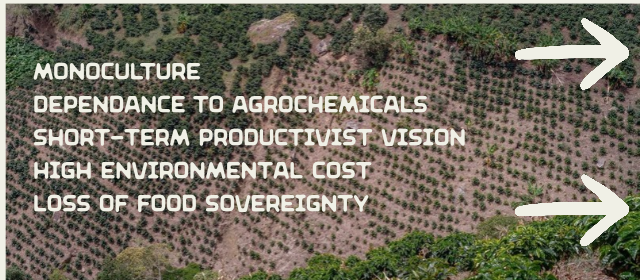
We think the way we grow food today is unfit for the future. Intensive monocultures are depleting the soil of its microbiology, nutrients, water and structure. Our food system is dependent on external agrochemicals, whose cost increase progressively, indefinitely. And coffee production is no exception.
We need to move away from this dependency and restore our soil’s natural fertility. But there is no single recipe for how to do this. The future of agriculture and the path towards soil regeneration is something we need to explore together — through farmers experimenting, observing, sharing and learning from one another.
Basically, we would like to encourage producers to go from (left) to (right) :
The regenerative journey
It feels difficult to get started as the project seems so immense. But regenerative farming advocates often talk about the the journey rather than the end result. It does not matter where you start, the idea is that you move towards practices that rehabilitate soil health, step by step.
We start by tackling excessive fertilizer use
The first step we have identified in Huila is to reduce the excessive use of synthetic fertilizers.
> 50 years ago, most Colombian coffee producers were not using any synthetic fertilizers, and produced more coffee per hectare than today.
> 10 years ago, they were applying around 150g per coffee plant, every quarter.
> Today we hear producers applying up to 300g per plant, 4 times a year. And productivity keeps going down, only compensated by an increasing coffee tree density.
Excessive fertilizer in the soil disturbs the balance of soil microbiology, which in turn disrupts nutrient cycling and acidifies the soil. It is a waste of resource and money since a plant won’t have the capacity to absorb it all- and consequences can go beyond the farm itself: for instance, the non-absorbed synthetic nitrogen will chemically transform and turn into molecules that will leach down and pollute groundwater, our potable water sources, rivers, and eventually the ocean.
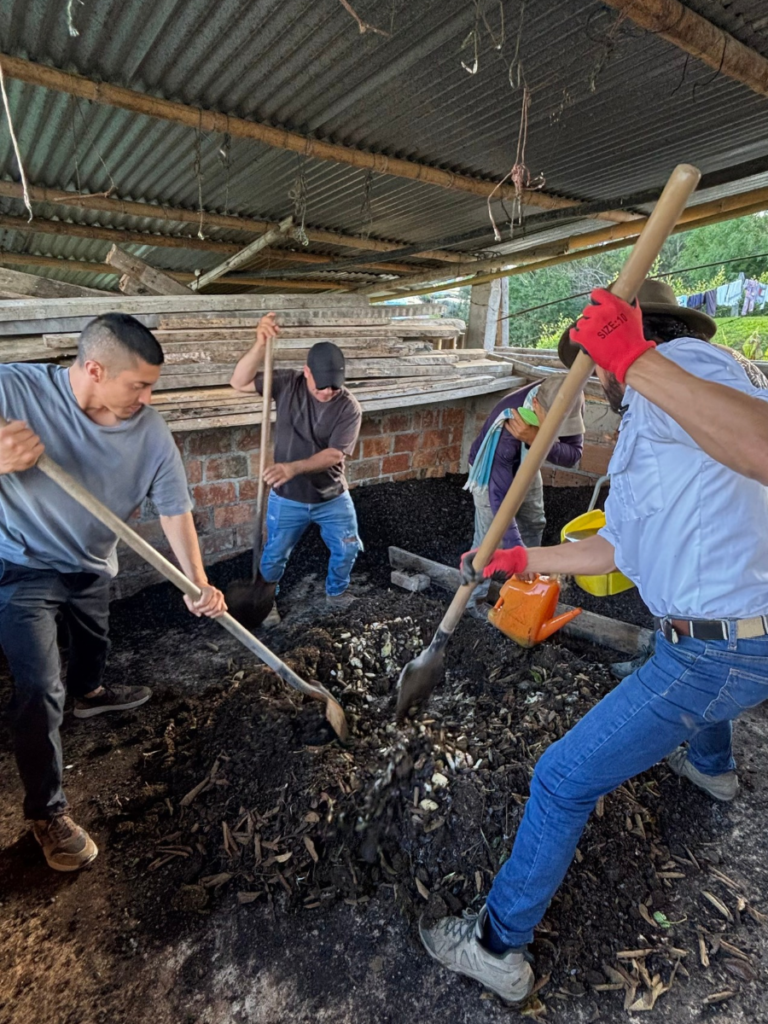
So we have gathered producers of our Minga network, together with 2 different agronomists, in 3 separate sessions, to get the conversation started. The idea is to present the problem and solutions. To our first identified issue – excessive use of fertilizers – the solution we offer is to do soil analysis and define the reasoned amount of synthetic fertilizer needed, rather than a random amount dictated by general practice. And at the same time, we encourage and train producers to start making their own natural fertilizer, like Bocashi – a potent natural, fermented compost ready to use in less than 3 weeks.